For listening tests, synthesized dialogues are rendered to full-duplex speech with Chatterbox TTS.
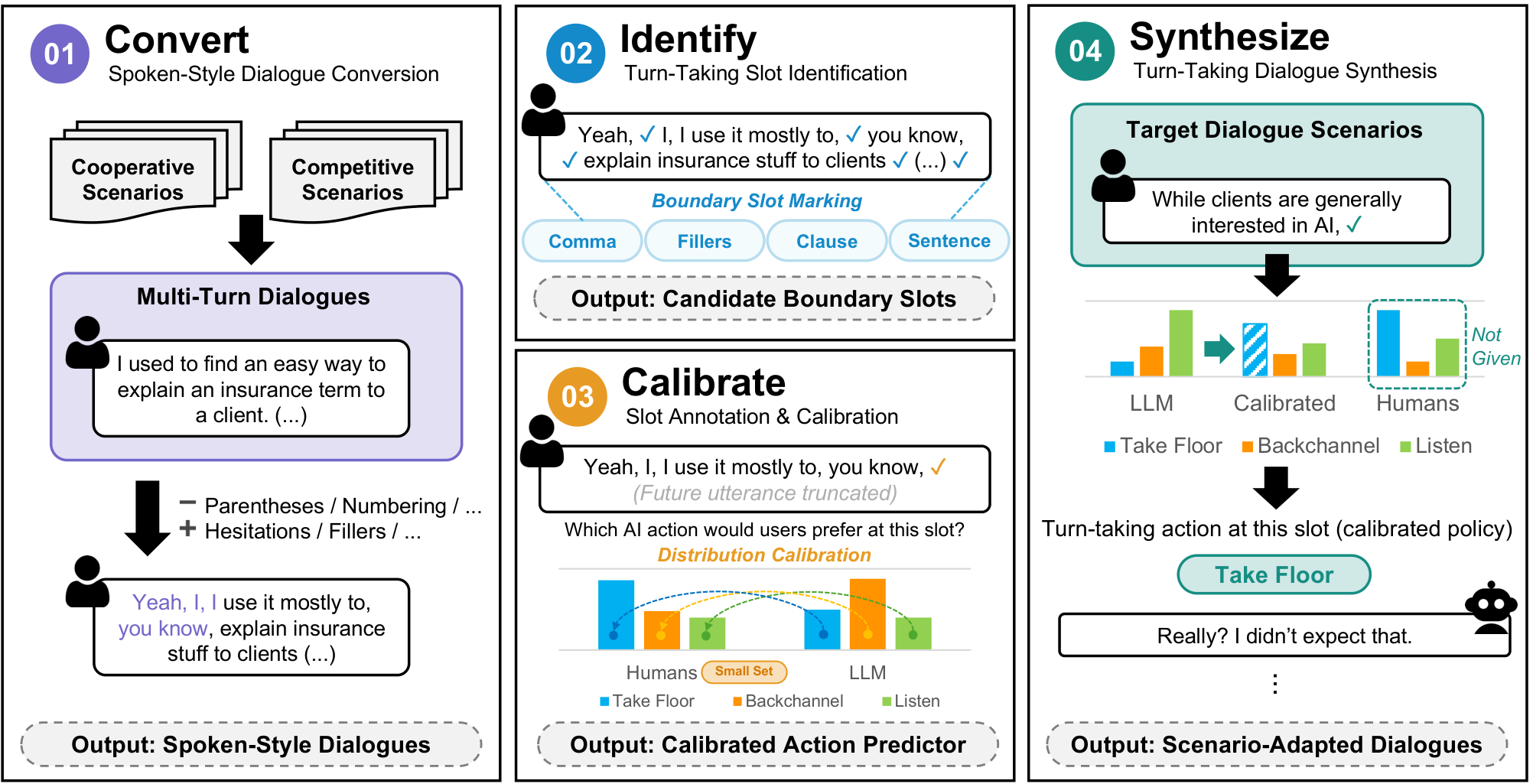
Turn-taking is a central component of full-duplex interaction. Which turn-taking behaviors are appropriate varies with the scenario, yet current models apply a single norm regardless of context. This limitation originates in their training data: human–human speech corpora capture natural timing phenomena but provide little role grounding or scenario-specific norms, while heuristic or prompted synthesis methods inject turn-taking behaviors without basing them on human preferences. We introduce DuplexGen, a framework for generating dialogues with scenario-adaptive turn-taking by calibrating LLM predictions against a small set of slot-level human preference annotations. In six cooperative and competitive tasks, human turn-taking preferences differ systematically, and DuplexGen aligns substantially more closely with those preferences than uncalibrated prompting or training solely on generic human–human data; a full-duplex model trained on DuplexGen-generated data exhibits distinctive, human-preferred turn-taking behaviors. These results show that human calibration, not corpus scale or prompt design alone, is what allows turn-taking synthesis to be scenario-specific.
Imagine an AI tutor that interrupts whenever a student hesitates, and an AI negotiator that patiently waits while the other side takes control. Both systems may generate perfectly fluent responses, yet neither understands when it should speak. Effective spoken AI must decide not only what to say, but also when to listen, backchannel, or take the floor; the right decision depends on its role.
Four stages turn clean text dialogues into human-calibrated, scenario-adaptive turn-taking dialogues.
For listening tests, synthesized dialogues are rendered to full-duplex speech with Chatterbox TTS.
Cooperative and competitive human–AI tasks, each grounded in an established dialogue dataset. Turn-taking norms differ significantly across them.
TEA: Socratic Teaching
Guided knowledge discovery, where the tutor leads a student through a problem rather than giving the answer.
Source: SocraticLM
PLN: Mixed-Initiative Planning
Collaborative goal completion, gathering information and comparing options toward a plan.
Source: MultiWOZ
INT: Interview
Structured information elicitation through open-ended questions and follow-up probing.
Source: Anthropic Interviewer
NEG: Negotiation
Resource allocation under conflict: bargaining over price and terms toward a deal.
Source: CraigslistBargain
PER: Persuasion
Attitude-change attempts, steering the other party toward a position or action.
Source: DailyPersuasion
SOC: Social Chat
Peer-like conversation with everyday, emotionally charged give-and-take.
Source: SODA
One DuplexGen-synthesized full-duplex dialogue per scenario, rendered with Chatterbox TTS. The full corpus is on the Hub.
TEA: Socratic Teaching
PLN: Mixed-Initiative Planning
INT: Interview
NEG: Negotiation
PER: Persuasion
SOC: Social Chat
Each waveform is dual-channel: top: human, bottom: AI assistant. Click a waveform to play.
Scroll horizontally to view all columns.
| Scenario | Instruction Following | Turn-Taking Naturalness | ||||
|---|---|---|---|---|---|---|
| Moshi | PersonaPlex | PersonaPlex + DuplexGen | Moshi | PersonaPlex | PersonaPlex + DuplexGen | |
| TEA | 1.44± 0.12 | 2.96± 0.26 | 3.40± 0.29 | 3.09± 0.15 | 3.37± 0.12 | 3.75± 0.11 |
| PLN | 1.40± 0.12 | 2.04± 0.16 | 1.72± 0.14 | 3.59± 0.13 | 3.73± 0.10 | 3.76± 0.09 |
| INT | 3.96± 0.23 | 3.76± 0.28 | 4.09± 0.32 | 3.68± 0.10 | 3.56± 0.11 | 3.56± 0.12 |
| NEG | 2.12± 0.22 | 4.00± 0.25 | 4.12± 0.20 | 3.46± 0.12 | 3.60± 0.10 | 3.63± 0.12 |
| PER | 3.12± 0.31 | 3.96± 0.30 | 4.12± 0.21 | 3.60± 0.14 | 3.49± 0.12 | 3.75± 0.11 |
| SOC | 3.64± 0.29 | 3.72± 0.30 | 3.92± 0.26 | 3.46± 0.13 | 3.57± 0.11 | 3.69± 0.10 |
| Avg. | 2.61± 0.12 | 3.41± 0.12 | 3.55± 0.12 | 3.48± 0.05 | 3.56± 0.05 | 3.69± 0.05 |
Turn-taking preferences differ by scenario. Human annotations show significantly different action distributions across nearly all scenario pairs: backchanneling is more frequent in cooperative tasks, floor-taking in competitive ones.
Calibration recovers human-like turn-taking. DuplexGen's calibrated predictions align far more closely with human slot-level preferences (lowest KL divergence) than uncalibrated prompting or predictors trained solely on generic human–human speech, which over-predict silence and under-predict backchannels.
Synthesized data shapes full-duplex behavior. A full-duplex model fine-tuned on DuplexGen dialogues (PersonaPlex + DuplexGen) exhibits distinctive, human-preferred turn-taking that adapts per scenario, and is rated significantly more natural than the Moshi and PersonaPlex baselines.
See the paper for the full evaluation protocol, baselines, and per-scenario numbers.
@misc{kim2026duplexgenadaptivesynthesishumanai,
title={DuplexGen: Adaptive Synthesis of Human-AI Turn-Taking Dialogues},
author={Takyoung Kim and Kang-wook Kim and Sang Hoon Woo and Julia Hirschberg and Gunhee Kim and Dilek Hakkani-Tür},
year={2026},
eprint={2607.26178},
archivePrefix={arXiv},
primaryClass={cs.CL},
url={https://arxiv.org/abs/2607.26178},
}